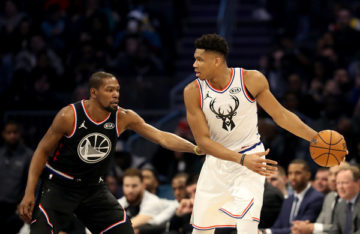
A Young Man’s League but an Old Man’s Game

In 1965 a 58 year old Satchel Paige took the mound for the Kansas City Athletics and simultaneously altered what we had come to understand as the correlation between age and professional sports. Though Paige faced just 10 batters during the ’65 season, his appearance gave grounds for the modern athlete to push the boundaries of time. Nearly half a century later baseball saw the likes of Julio Franco, 48, don a starting first base job for the 2007 Mets and Jamie Moyer, 49, claim a spot in the Colorado Rockies’ 2012 rotation. While the relationship between age and success is starkly different between baseball and basketball, today, the NBA currently boasts three active players over the age 40.

Basketball fails to employ aging veterans quite the same way that the MLB, NHL, or even the NFL can. In fact, the NBA’s oldest players, Nat Hickey of the 1948 Providence Steamrollers stakes claim as the league’s oldest only maintaining a slim lead of Robert Parrish, who at age 43 was able to take home a slice of the Bull’s 1997 NBA title and almost ten years later the Dallas Mavericks employed 44 year old Kevin Willis. Hickey, Parrish, and Willis are the exception, not the norm in a game that is continually getting younger, faster and more athletic.

The NFL boasts several positions that organically provide positions that allow veteran players to play well into their 40’s. Players like George Blanda of the 1975 Oakland Raiders kicked his way to his 48th birthday while wearing the black and silver but even quarterbacks, Warren Moon and Steve DeBerg, both roamed the sidelines into their 44th birthday.

Today we examine the NBA’s most veteran group, a panoply of names that continue to push to proverbial envelope of what we can expect from the aging athlete. In this we will not only examine the year that was for these inveterate players but also what 2013-2014 will bring.

Grant Hill, Los Angeles Clippers

After a 2012 summer of deliberation Grant Hill decided to return for his 19th NBA season. At age 40, the former third overall pick from the 1994 draft has done plenty to merit his nomination into eventual Springfield enshrinement but his current state does little to vouch for what has been an incredible career. Hill’s minutes have evaporated for the Clippers who were only able to find a meager 15.1 MPG over 29 season appearances for the veteran while stashing him on the pine during the club’s 2013 playoff run.

This appears to be the end for Hill who will be remembered as the NBA version of baseball’s 5-tool player. Hill could do it all, and he did. The NBA hadn’t seen a player flash such an array of skills since Oscar Robertson and the league wouldn’t see another star display such a collection of skills until LeBron James. Compare Hill’s 1999 -2000 season to LeBron’s latest:

Hill (’99-’00): 25.8 PPG, 6.6 RPG, 5.2 APG, 1.4 SPG, 80% FT, .489% FG

James (’12-’13): 26.8 PPG, 8.0 RPG, 7.3 APG, 1.7 SPG, 75% FT, .565% FG

Ankle injuries rerouted Hill’s career in his prime but he continued to play for another decade after finally taking a back seat to his more able bodied teammates. Hill will likely finish in the top 100 all time in scoring, currently 81st with 17137 career points and 79th in career assists with 4252. If this is in fact the end for Hill, he will be remembered for stuffing the nightly stat sheet, making FILA shoes cool again, and showing that a star can overcome injury.

Juwan Howard, Miami Heat

Twenty years after Michigan’s Fab Five run to the NCAA final four, the only remaining player from Steve Fisher’s talent laden team still playing in the NBA is Juwan Howard. Drafted 5th overall in 1994, two picks after the afore mentioned Grant Hill, Howard has made a living as of late by serving as a veteran presence for Miami Heat, Portland Trailblazers, and the Charlotte Bobcats. The 40 year old played in just seven games this season for Miami (starting two of those) but is more often seen taking a coaching and development role in his warm up jacket.

At 6’9’’ there may be another one year contract in store for a player his coaches and teammates attest is an ultimate “high-character guy” and role model for younger players.

“[Juwan] absolutely fits into the fabric of our culture,” Heat coach Erik Spoelstra told the press earlier this season. “To be honest, it felt a little bit strange not having him with us [while Howard was playing in the developmental league]. It makes sense, it feels right.”

Jason Kidd, New York Knicks

Jason Kidd may not dominate games quite like he did a decade ago when he delivered back-to-back Finals appearances for the then New Jersey Nets, but Kidd is still a valuable asset for one of the Eastern Conference’s top teams. With 105 career triple doubles (third all time behind Oscar Robertson’s 181 and Magic Johnson’s 138), Kidd’s game no longer fills the stat sheet but instead the crafty guard has learned to influence the game in other ways.

Kidd played in 76 of New York’s 82 games while staying relatively healthy throughout the year and giving the Knicks much needed leadership when incumbent point guard Raymond Felton missed time with injuries. Like a flame throwing pitcher who must evolve his game as his MPH begins to drop, Kidd has continued to improve his shooting as he’s aged which has helped to make up for his declining first step. To fully grasp the improvement in his shooting, here are his 3-point shooting statistics from his first two years compared to two of his last season’s as a full-time starter:

‘94-‘96 3-point shooting: 203/653 = 310%

‘08-’10 3- point shooting: 307/737 = 417%

The Knicks will happily extend the option for the veteran guard to return in 2014. His minutes should remain steady should he accept the role of backup point guard though he the opportunity to catch John Stockton atop the league’s all-time assist list won’t be happening regardless of where he lands (Kidd currently 2nd with 12091 trails Stockton’s 15,806).

Jerry Stackhouse, Brooklyn Nets

“Stack” currently ranks as the league’s 8th oldest player at 38 years old and 170 days though it seems like years since the former North Carolina Tar Heel actually played a significant role. The veteran guard hasn’t averaged double digit scoring totals since 2007-2008 with the Dallas Mavericks (10.7 PPG) and has started just two games since then.

Stackhouse’s role has transformed into the role of spot-up shooter and reliable free throw shooter in crunch time (87% in ’12-’13). 88th all-time in scoring with 16,409 career points, he likely won’t have the opportunity to add to this total next year unless a team is willing to take on an aging guard who provides little practical on-court use.

We’ll remember Stackhouse for his role on playing alongside a young Allen Iverson which provided one of the most exciting young backcourts in the NBA. Later “Stack” went on to Detroit where he would challenge for the 2000-2001 scoring title with an impressive 29.8 PPG. When he does decide to hang ‘em up Stackhouse’s career may compare favorably with the likes of players like Mitch Richmond:

Richmond: 21.0 PPG (20,497 career), 3.5 APG, 3.9 RPG, 1.2 SPG, 85% FT, .388 3 PT %, .455 FG%,

Stackhouse: 16.9 PPG (16,409 career), 3.3 APG, 3.2 RPG, 1 SPG, 82% FT, .309 3PT %, .409 FG%

If these players had their druthers they’d cajole David Stern into increasing the league’s age limit from 19 to 21 so to buy time for the game’s aging stars. In the meantime, some of these seasoned players will find teams in 2014, and if they do, we’ll continue to borrow from Satchel Paige in our view of the aging athlete:

“Age is a case of mind over matter. If you don’t mind, it doesn’t matter.” ‘

Try convincing the league’s 29 General Managers of that.


2013 Fantasy Basketball, Value Keepers: Guards & Forwards

Fantasy Basketball Isaiah Thomas

Photo Credit: Ezra Shaw/ Getty Images NA

Tobias Harris, Orlando | Final Ownership: 86% | 2012-2013 ADP: 149

One team’s serviceable player is another team’s superstar in the making. Harris rated amongst the most versatile and dynamic fantasy options during his 27 games with the Magic: 17 points and nine rebounds, with a steal, block and three-point make (not to mention 3.4 assists per game in April). His style will likely be more under wraps and less freelance as Orlando tries to establish a team identity, but on any given night no key statistic is out of bounds. With that said, don’t expect the same quantity of three-point attempts in future seasons. His teammate, small forward Maurice Harkless (ADP: 157), also possesses tremendous fantasy promise. He started 59 games as a rookie, filling up defensive categories on a nightly basis and upping his scoring average by 8.6 after the All Star Break.

Kawhi Leonard, San Antonio | Final Ownership: 84%| 2012-2013 ADP: 121

Leonard remains a tad rough around the edges, but he has a solid framework of skills to build on. After shooting 40% from three in the first half, his efficiency retreated to the mean as he dipped to 32% in the second half. If Leonard can combine his advanced mid-range game with consistency spotting up from deep, he can develop into an elite role player. He averaged 12 points on 50% FG, six rebounds and 1.7 steals in 57 games as a starter. He missed time with both knee and quadriceps injuries; if healthy, Leonard should see 35+ minutes in his defining third season.

Jimmy Butler, Chicago | Final Ownership: 52% | 2012-2013 ADP: 177

The 30th pick of the 2011 first round, injuries cracked open the door for Butler in his second year and he exploded on through behind substantial minutes. He had a large say in determining fantasy champions during the month of April scoring 15 points, grabbing seven rebounds, dishing out three assists, swiping 1.7 steals and shooting 56% from distance in ten games. While Butler is a definite position tweener at 6’7 220, he’s improved his shooting stroke and brings defensive versatility that the Bulls covet. He will be a rotation mainstay next season even on a healthy roster.

Isaiah Thomas, Sacramento | Final Ownership: 88%| 2012-2013 ADP: 92

Thomas did not always see eye to eye with head coach Keith Smart, and he has obvious point guard limitations (which is why he almost went undrafted in ’11), but man is he explosive. Thomas finished the season at 14 points and four assists per game in just 27 minutes, figures that escalated to 17 and five post All Star break (still in only 31 minutes). He shot 36% from distance at 5’9, and ranked 7th in the NBA in free throw accuracy at 88%. With Smart highly unlikely to return on the sidelines, Thomas has legitimate top-15 PG potential heading into next year. It should be noted that Thomas and Tyreke Evans sharing one ball will never be a settled situation.

Gerald Henderson, Charlotte | Final Ownership: 91%| 2012-2013 ADP: 105

Henderson followed up a strong 2011-2012 season with another underrated campaign, particularly his standout second half. Post ASB Henderson averaged 19 points, four rebounds, three assists and a steal. A slasher by trade, he got to the free throw line nearly six times per game over that period, converting upwards of 84%. Henderson will be a restricted free agent in the fall, and has already expressed his desire to remain with the Bobcats. Keep in mind that Michael Kidd-Gilchrist with a year of experience under his belt will eat into his overall productivity. Henderson won’t turn 26 until December.

*Ownership Percentages/ADP provided by CBS Sportsline

*All statistical data provided by Yahoo! Sports

Follow on twitter @AdamGaneles

2013 Fantasy Basketball, Value Keepers: Men in the Middle

Fantasy Basketball Nikola Vucevic

Photo Credit: Chris Trotman/ Getty Images NA

Nikola Vucevic, Orlando | Final Ownership: 98% | 2012-2013 ADP: 143

During the draft process, knocks on Vucevic were centralized on his questionable explosiveness and lack of foot speed. It’s safe to proclaim that his skill level and instincts have far and away superseded any perceived weaknesses. Post-All Star Break Vucevic averaged 15 points, 13 rebounds and two assists. He finished his sophomore campaign 2nd in the NBA in rebounding, which includes four 20-board games. While his shot blocking for a seven-footer leaves something to be desired, it won’t hold him back from elite center status in 2013-2014. He’ll team with fellow sensational keepers Tobias Harris and Maurice Harkless in the Magic frontcourt.

Omer Asik, Houston | Final Ownership: 97% | 2012-2013 ADP: 126

Perched directly behind Vucevic in the rebound leaders is Mr. Asik. The seven-footer from Turkey showed glimpses of his glass eating prowess with Chicago (five rebounds in 15 minutes), but he cemented himself as a double-double machine for the Rockets averaging ten points and 11.7 boards. Fact: Asik made only nine shots outside of the paint all season. Fact #2: His fantasy owners could care less about his limitations. He’s an old-school defensive anchor with a dirty work persona. Asik won’t slip past the third or fourth round.

Jonas Valanciunas, Toronto | Final Ownership: 63% | 2012-2013 ADP: 134

Big V stepped up his production in the season’s final seven contests to the tune of 15 points, 6 rebounds and 2.4 blocks per game. It’s hard to get carried away with a small sample size of meaningless basketball, but the potential is undoubtedly present. Perhaps most importantly, he stepped up his aggression level and got to the free throw stripe 7.7 times (85%). The Raptors are high on their big man, and the 7’0 260 pounder could develop into a focal point on the interior next season and subsequently a top-10 pure center option. He shot 64% on looks five-feet and in.

Andre Drummond, Detroit | Final Ownership: 63% | 2012-2013 ADP: 138

Drummond was a rebound and hustle category dynamo prior to being sidelined with a stress fracture in his back. Upon returning, he played solid ball over a ten-game span (in constrained minutes) to alleviate concerns going forward. Possessing the agility and lateral quickness of a guard at 280 pounds, his athleticism can absolutely wreck a game and fill up box scores. Free throws are a major concern at 37%, but watching him throw down alley-oops (31) with regularity takes away the sting. Drummond will assuredly be a draft day darling next year. Only 19-years of age, his ceiling is unlimited.

Enes Kanter, Utah | Final Ownership: 27% | 2012-2013 ADP: 151

With the Jazz frontcourt in a state of flux, Kanter is expected to assume a prominent role for years to come. Prior to dislocating his shoulder, the 20-year old from Switzerland compiled 11 points on 59% shooting and six rebounds per game in the month of March – in UNDER 20 minutes. In his two game starts this year he scored 41 points, grabbed 30 boards and made 61% of his field goals. By the end of next season, Kanter will have burst away from sleeper status.

Meyers Leonard, Portland | Final Ownership: 12% | 2012-2013 ADP: 156

Leonard exhibited tremendous development in the second-half of his rookie season. He’s added substantial muscle mass in a short period of time without hindering his agility. Add an improving frame to his soft shooting stroke at 7’1, and there’s an awful lot to look forward to. Leonard shot 39% on mid-range jumpers (37 makes) and occasionally showed off his three-point range (3/7). In six games without LaMarcus Aldridge in the lineup during late March and April, Leonard averaged 12.5 points and six rebounds per. He’s still probably more of a long-term keeper or dynasty target, but he’s oozing with potential and realizing it at an escalated pace.

*Ownership Percentages/ADP provided by CBS Sportsline

*All statistical data provided by NBA Stats

Follow on twitter @AdamGaneles

The Art of the Mid-Range Game

Fantasy Basketball Chris Paul

Photo Credit: Noah Graham/NBAE via Getty Images

The top 10 mid-range shooters in the NBA, by percentage, with a minimum of 75 makes:

1.       Serge Ibaka, PF|50.5% – A player who can block upwards of three shots per game and connect on 162 mid-range jumpers is a true diamond. Ibaka has occasionally incorporated the three-ball to his repertoire as well (20). He’s all catch-and-shoot with 90.1% of his makes being assisted.

2.       Chris Bosh, PF|50.2% – Since joining the Heat in 2010, 42.4% of Bosh’s buckets have come from the mid-range. Given that he’s shooting only 33.6% in the paint (non-restricted area), he’s wise to stick with his calling card 18-foot elbow jumper.

3.       Luke Ridnour, PG|49.8% – Ridnour is a rare breed in that he prefers the mid-range to the three-point line. In fact, his numbers beyond the arc have dipped precipitously the past two seasons (31%). His small stature and lack of explosive athleticism prevents him from finishing on the interior; the result is 400 attempts between the paint and the three.

4.       Steve Nash, PG|49.7% – Nash is efficient everywhere – when he gets on the floor—62.3% in the RA, 47.5% in the paint and 43.8% from distance. Of his 83 mid-range conversions, 81.9% are self-created looks.

5.       Chris Paul, PG|49.2% – The run on point guards continues with CP3, whose peripherals combine a touch of Ridnour with a splash of Nash. Like Ridnour, Paul gravitates to the mid-range J before the three-pointer to the tune of 307:227. Like Nash, 81.5% of his makes come off the dribble; to the surprise of no one.

6.       Patrick Patterson, PF|48.5% – Back to power forwards we shall go with the oft-overlooked Patterson. The former Kentucky Wildcat is the master of the pick and pop (95.5% AST), knocking down 111 mid-range jumpers compared to only 116 conversions five-feet and in. Also boasting 50 three-point makes on his resume, Patterson is a matchup nightmare.

7.       Dirk Nowitzki, PF|48.1% – Old reliable would never miss an opportunity to crash this list. Nowitzki has 206 mid-range makes in just 52 games (277 in 2011-2012). His portfolio is balanced with 63.1% the result of an assist and 36.9% off isolation.  It should be noted that his activity in the paint has all but disappeared following knee surgery (1.25 FG/game).

8.       Jason Smith, PF|48% – Smith, one of the more underrated glue guys in the NBA, makes his hay on post defense and his aptitude on the catch-and-shoot (pick and pop). 204 of his 341 total field goal attempts have come in the mid-range. He hasn’t played a game since February 26th due to a torn labrum.

9.       Marc Gasol, C|47.9% – Our first true center. Shooting just 43.2% in the paint (non-RA) at 7’1, it’s fortunate that Gasol is quite effective in the high post. He has 154 mid-range J’s on his ledger, most of which catch nothing but the bottom of the net.  Additionally, Gasol is facilitator supreme, creating easy hoops for his mates with regularity (4 APG).

10.   Tony Parker, PG|47.8%- Despite lack of a pure distance stroke, Parker epitomizes the pick and roll point guard. When he doesn’t get to the rim (59.7% eight-feet and in), he’s made 162 jumpers in his new comfort territory in 65 games played. Parker shot 39.8% from mid-range last year; he’s still improving, and that’s a frightful reality for defensive game plans league wide.

Breakdown:

  • 5 PF, 4 PG, 1 C
  • 6 on +.500 teams
  • 8 Western Conference members

Others worth noting:

Kawhi Leonard shot 49.1% but his 56 makes didn’t qualify; Marreese Speights has connected on 118 mid-range jumpers in 18 minutes per game; J.J. Redick was the top qualifying shooting guard at 44.1%; in terms of quantity, LaMarcus Aldridge led the way with 312 (42.8%), followed by DeMar DeRozan at 258 (40.8%) and Carmelo Anthony at 256 (44.6%).

*All data provided from NBA Stats

Follow on twitter @AdamGaneles

Daily Fantasy Basketball: Versatile Rooks

Fantasy Basketball Evan Fournier

Photo Credit: Doug Pensinger/ Getty Images NA

Evan Fournier is a name you’d be wise to monitor down the final stretch run. The Nuggets under the radar 2012 first-round selection (#20 overall) has burst onto the scene over the past ten days on a suddenly crippled roster. In his last four games Fournier is averaging 14 points on 55% shooting, three assists against a single turnover, two rebounds, two steals and 1.25 three-point makes in just 21 minutes. A product from French first division pro ball, he’s a 6’7 off the dribble playmaker with improving consistency from range; both skills will come in handy for Denver with Ty Lawson nursing a heel injury and Danilo Gallinari done for the year with a torn ACL. Fournier is a not startling athlete, but he’s crafty and can function at multiple positions. The risk in utilizing him is inherent given his somewhat limited playing time to this point; however, should he find an appropriate matchup to crack the 30-minute plateau, there is a ton of upside here at a gift DraftKings salary.

Nando De Colo, who also happens to be a native of France, is assembling solid statistical lines as of late for the Spurs. With Tony Parker’s playing status up in the air on a daily basis, De Colo will be a valuable piece for the remaining five contests. In four April games thus far he’s averaging eight points, six rebounds, three assists (2.8 turnovers) and a steal in 22 minutes of action. At 6’5 190, he’s an excellent rebounder for a point guard and is shooting 48% from downtown post all-star break.  While not an experienced NBA commodity by any means, the 25-year old has more basketball experience than a Cory Joseph or Patty Mills. Overall, he brings an intriguing fantasy package to the table at an enticing daily salary, particularly with Parker a real shutdown candidate. *San Antonio is currently one game up on Oklahoma City for home court.

In three games since being recalled from the Developmental League, rookie Terrence Jones has picked up 24 minutes per off the bench and displayed his box score filling potential. He notched a 14/12 double-double at Sacramento with eight offensive rebounds and two steals; at Denver he scored 13 points, grabbed six boards, blocked two shots, hit two treys and swiped a steal. Of course Jones threw in an absolute clunker in between, but there’s a reason he’s a minimum salary player. Versatility was his defining attribute at Kentucky, and should remain so in the NBA when given an opportunity to strut his stuff. The Rockets are not remotely hesitant to lean on their young talent. On that note, don’t ignore Patrick Beverley either (seven assists per game over his last three).

Keep tabs on these minimum salary/high upside options in DraftKings daily fantasy cash games, where you can enter their weekly $10,000 “Big Wednesday” tournament for $11.

Follow on twitter @AdamGaneles

One Side of the Ball: Offense Reins Supreme

Last week Major League Baseball celebrated the 40th anniversary of the designated hitter. The position, originally constructed to inject more offense into an otherwise slowing game, has added new life to the sport while singlehandedly deitizing one-dimensional players like Edgar Martinez, Frank Thomas, and Harold Baines.

The sport of basketball fails to lend itself to such a position but one must wonder what would happen if the NBA could somehow support players who played on just one side of the ball. Aside from superficial stats like rebounds, blocks, and steals, very few commonly used measurements consider the other half of basketball, the defensive end.

Today we explore the concept of the NBA’s version of the designated hitter: players whose lone task is to play and facilitate offense. The players mentioned below may fail to earn the playing time their offensive peripherals may suggest for the simple reason that they are in fact offensive players.

Jamal Crawford: Compiling this list wasn’t difficult. What was difficult however was deciding who plays the most lackluster defense while simultaneously bringing elite-level offense to the court. Hands down Jam Crawford wins here.

Photo Credit: Allen Einstein- Getty Images

Photo Credit: Allen Einstein- Getty Images

Many thought that New Orleans won the lottery last summer in landing franchise pillar Anthony Davis when in fact the real winner of last offseason was Jamal Crawford. After suiting up for five teams over the past four years, Crawford has found his basketball bliss on a team that needs him to do what he does best: score the ball.

The veteran guard has done just that. Crawford has been given generous looks at the basket considering he hasn’t started a game all season, and leads the Clippers in shots per game (13.5), ahead of proven scorers like Chris Paul, Blake Griffin, and Caron Butler.

The offensive honeymoon gets even sweeter for the former Michigan Wolverine. 2013 is proving to be one of Crawford’s best shooting seasons overall. A near career best 44% from the field makes him a reliable weapon for Los Angles who will need the talented combo-guard to slash versus weak interior teams and stretch defenses with his improved perimeter range.

Without question Crawford is the biggest difference between this season and last for a supremely skilled team. With defensive responsibility delegated to players like Matt Barnes, Eric Bledsoe, and DeAndre Jordon, Jamal Crawford has found his own Eden on Figueroa Street in Los Angeles.

Charlie Villanueva: The remaining two years of Charlie Villanueva contact is the only thing uglier than watching the 6’11’’ forward settle into a defensive stance. Scouts long overlooked his shortcomings because of his versatility once the ball crosses half court.

A former lottery pick, and the owner of a 5-year $38MM contract awarded before the 2009-2010 season, Charlie V displayed shown flashes of his offensive aptitude but has shown Detroit nothing more than a lackluster effort without the ball in his hands.

Though his shooting numbers suggest otherwise (an abysmal 38%/34%/55%), the former UCONN Husky has the capability to contribute quite a bit offensively. A career 44%/35%/78% garners hope that given extended time Villanueva has the overall skills to contribute—at least offensively.

The lowly Pistons aren’t the right fit for Villanueva and his albatross of a contract is nearly impossible to move should a team desire a versatile scoring threat.  All this together leaves this talented offensive weapon to rust buried at deep end of Detroit’s bench.

Steve Novak: Last July the Knicks extended their sharp-shooting threat Steve Novak, giving him a 4-year $15MM extension to simply shoot the basketball and function as a perimeter threat. Having him on the floor has done wonders for Carmelo Anthony and Ray Felton, two players who are enjoying superb offensive seasons (A career best 28.3 PPG for Anthony and a respectable 14 PPG for Felton while also serving as the team’s distributor).

New York understands that the former Marquette star won’t be seeing minutes guarding Jeff Green or Loul Deng come playoff time, but the Knicks have long tried to hide him while still reaping the benefits of his offense. For the most part Mike Woodson and co. have been quite successful in doing this and one might even think that Novak could perhaps be a functional defender. He has quite a bit going for him: Novak is long—at 6’10’’ he’s usually asked to guard opposing small forwards who are three –four inches shorter and he has average lateral quickness which may make it easier to keep him on the floor during tight 4th quarter situations.

Ultimately Steve Novak won’t ever lose the label as a “below-average” and opposing wings will forever become giddy at the prospect of a Novak matchup. Those in The Big Apple will however enjoy the marksmanship of one of the game’s best jump shooters for the next four years.

Nick Young: It was a surprise to see the trade deadline pass and Nick Young still find himself a member of the 76ers. Teams like Chicago and Memphis who both find themselves in the bottom 1/3rd  of the league in total offense could have benefited from Young’s relentless offensive attack—even if it does mean conceding a bit on defense.

Young has never been given an opportunity at major minutes on any of the three teams he’s played for mostly because of his dreadful defensive effort. The intrigue lies in what he’s able to do in just limited action. While never logging more than 31 nightly minutes for any team, Young has posted yearly scoring averages just short of 20 PPG.

This summer the former USC standout will hit the open market with the intention of latching on with a contender who can afford to let Young attack the rim and catch his breath on defense.

Mike Dunleavy: Dunleavy’s matador defense has kept the former Duke Blue Devil from ever becoming the player fans once expected when he was drafted 3rd overall in 2002. At 6’9’’ he’s able to earn his keep by scoring the ball from multiple positions and his long arms plus a high release will likely help him find employment in coming years.

Like Steve Novak, Dunleavy has carved out a niche for himself as an elite shooter and has made this season a high-water-mark. Posting a career best 43% from three has made Dunleavy the stereotypical offensive specialist.

Scouting the Final Four: Point Guard Lotto

College Basketball Trey Burke

Photo Credit: Adam Glanzman

Trey Burke, PG Michigan- Burke has earned himself a healthy payday come June with his machinelike consistency (double figures scoring in all 37 games) and efficiency (46%/38%/80%) as a junior. Entering the NCAA Tournament, it was believed by most NBA decision makers that Burke had already shown his full repertoire, and that his draft stock was essentially set in stone. Frequent knocks on Burke surrounded his casual demeanor and somewhat emotionless on-court style – in other words, how much does he want it? The final 1:55 of regulation and proceeding overtime against Kansas on Friday the 29th put an end to those queries. 6:55 of innate fortitude and shot making, of carrying his teammates over the finish line, singlehandedly moved him up a handful of spots in the lottery. Burke is not the quickest point guard in America, but he’s mastered the “change of pace” and has the ball on a string. He does his best work shooting off the bounce, using his handle and/or compact frame to create space for his patented step back jumper.  As a result of his proficiency converting low percentage jump shots, he can create his own shot at will, which ironically has often resulted in critical evaluation of his team running skills. However, it’s difficult to argue with 6.8 assists and a 3.4 AST: TO ratio. Burke’s comfort level in the pick and roll will serve him well at the next level. Many of the current lottery teams already have lead guards in place, but Dallas would be an ideal landing spot.

Michael Carter-Williams, PG Syracuse- Carter-Williams is still very much a work in progress and will require heavy seasoning in the pros. He possesses intriguing size and court vision for the position, dishing out double-digit assists on 11 different occasions. Carter-Williams truly thrives is in transition, where he can gallop like a gazelle and survey the court free of distraction. It’s in the half-court where the clutter clouds his decision making process, and he’s a frequent candidate to force the action unnecessarily (3.4 TO). Length and quickness can get him to the rim, but his lack of strength often prevents the finish or makes him skittish to seek out contact. He must add muscle to his 185 pound frame. MCW took advantage of a favorable matchup versus Indiana, scoring both inside the lane and behind the three-point line en route to 24 points. He posted a typical 12 point/8 rebound/6 assist/5 steal line versus Marquette. If (and when) he finds his footing at the next level, the above triple slash is very much indicative of his all-court potential. It’s difficult to gauge one-on-one defensive skills in a zone structure, but he possesses the requisite length to disrupt a game, that much is for certain. He’s currently slotted in the back end of the lottery, but Boston could be an interesting destination if he slips. Akin to Rajon Rondo, Carter-Williams is a viewed as a confounding variable among scouts and presents an unorthodox package for teams to evaluate.

Freshman to Watch: Jerami Grant, F Syracuse- Blessed with all the athleticism in the world, Grant lost his way when James Southerland returned to the lineup, and has subsequently lost his spot in the rotation. Nevertheless, he could play a large role crashing the offensive backboard against a finesse Michigan team undersized at the 4-spot. He’ll need to step foot on the court for more than three minutes to leave an imprint. Either way, next year will be an explosive step forward for Grant, a conceivable 2014 lottery selection.

Follow on twitter @AdamGaneles

2010 NBA Draft Class: Where are they now?

The 2010 draft class featured it all: the lightning quick point guard, a trio of promising big men, lanky and multitalented wings, and several front office Hail Marys. Just weeks away from season’s end, we’ll look back at the first three years from one of the most talent laden classes in recent memory.

From The Top (1-3)

John Wall: Do we think JOHN WALLJohn Calipari would have finished 21-12 with a loss to Robert Morris in the NIT opening round had Wall decided to remain a Kentucky Wildcat? This spring would have concluded Wall’s senior season at UK which may lend some perspective when evaluators seem ready to anoint him a managerial calamity.

Had Randy Wittman and co. had Wall’s services for a full season this team would be challenging for a 6th seed. Instead, Washington’s season was jolted forward when their star point guard returned to the lineup January 23rd. Since becoming part of the rotation Wall has been nothing short of what we’ve wanted to see on draft day: a do-it-all floor leader.

23-18: Washington’s record since Wall’s return. Not only has his return translated to wins but his statistical value has also been something to be coveted. Among his abridged season statistics Wall can boast a 47 point outburst and 11 games of double figure assists.

2013 has been the largest leap forward for Wall who continues to address his shooting prowess which has long been a slight. This season he’s shooting at career marks in nearly every category. 44% from the floor, 82% from the charity stripe, and a far from impressive, yet career best 31% from three point range.

A full season of Wall paired alongside shooting star Bradley Beal has the nation’s capital in a swivet as to what 2014 may bring.

Evan Turner: It was impossible to ignore the comparisons to Grant Hill the moment the ping pong balls fell in Philadelphia’s favor just three years ago. The former Ohio State standout has the tools to contribute in every facet of the game and it’s just now that he’s getting the chance to prove it.

As a rookie Turner started just 14 games for Philly and then just 20 during his sophomore season. This year, the talented wing has started every game and posted the numbers to justify floor time. An average better than 13 PPG alongside 6.4 RPG and 4.3 APG make Turner the complete package.

The Sixers played it safe selecting Turner 2nd overall though it would be difficult to argue his value above later draftees like Paul George, Greg Monroe, or DeMarcus Cousins.

Derrick Favors: Just months after snatching the young center with the 3rd overall pick the Nets shipped Favors in a package to land incumbent star Deron Williams. Fans in Utah have made the requisition to see more of the promising big man but Favors’ minutes have been sparse during his first three years as a pro.

The Jazz precipitancy to allocate minutes to Favors has been in large part due to competition for playing time (just 22:41 MPG this season compared to 20:11 as a rookie). Nestled in a crowded frontcourt among Enes Kanter, Paul Millsap, and Al Jefferson, Favors finds himself in the undesirable position of fighting for minutes among skilled, equally talented post players.

With both Jefferson and Millsap set to hit free agency this summer, 2014 may be breakout year for Favors. Like the aforementioned John Wall, Favors left the collegiate ranks after just his freshmen year meaning that had it been, say 1983, instead of 2013, we would be catching our first glimpses of Favors in 2013-2014.

The Hits:

Paul George: With the 10th pick Indiana laid a crushing blow to the remainder of the Eastern Conference when they landed Paul George from Fresno State. Indiana can boast one of the game’s most exciting small forwards who has been so good that the Hoosier state has hardly noticed the absence of Danny Granger.

Over his last 10 games George has averaged just under 20 PPG while reeling in over seven rebounds per contest. The emergence of Paul George gives his team a frontline of pharaonic proportions considering the commitment Indy has made to both Roy Hibbert and David West.

In just less than a month George will turn 23, and at the same time his team hopes to be advancing in the playoff picture which seemed inconceivable when team leader Danny Granger re-injured his left knee, requiring yet another surgery.

The derision directed at the Pacers won’t wane until George proves that his squad can deliver on the impressive regular season run his team has put together.

Eric Bledsoe: Stashed apace with John Wall at Kentucky, Bledsoe has yet to be given the full reins as a point guard but scouts have seen enough of the third year talent for his name to be mixed among trade deadline rumors featuring names like Kevin Garnett and Paul Millsap.

Things didn’t look so promising at the end of last season when Bledsoe minutes trailed off to a meager 11.6 per contest. Entering 2013 he seemed to be buried yet again behind veteran guards like Chauncey Billups and Chris Paul. Fortunately for Bledsoe a injury to Billups paved the way to playing time and a chance to reassert himself as one of the game’s most promising stars.

In games when he’s started (12 total this season) Bledsoe has shown off an array of talents such a 27 point explosion vs. Orlando, a 9-15 scorching of Boston in January, and multiple outings of double-digit assist numbers.

Selecting Bledsoe outside the lottery at 18th overall in 2010 now looks to be one of the steals of the draft but fans have yet to see just what this young guard is capable of once he’s handed an opening.

The Misses

Wesley Johnson: Just one season at Syracuse, preceded by a career at Iowa State seemed to be enough for executives to pull the trigger on Wes Johnson as the 4th overall selection in 2010. Since being drafted the rangy wing has seen nothing but nothing short of prosaic.

Soon to be 26, Johnson has yet to crack the 40% barrier as a shooter which ventures into near unplayable territory. Following two seasons in Minnesota the Timberwolves shipped the 6’7’’ forward to the Phoenix desert where he’s been even less of an impact. Starting a career low 13 of 42 games, Johnson hasn’t impressed the Suns enough to warrant playing time but then again, neither have his numbers.

Johnson owns a career low 7 PPG alongside paltry rebounding skills which make him near lock to be on the move yet again come season’s end. While Minnesota fans may blame Kevin Love’s wrist injury for their struggles, they may want to look back at the blunder of 2010 which may find Wes Johnson in draft-day infamy.

Xavier Henry: The Kansas Jayhawks have never been ones for one-and-done talents but Xavier Henry’s freshman year in Lawrence was nothing short of impressive. His 42% shooting clip from three-point range gave hope that Henry’s sweet lefty stroke would translate to the professional ranks however the NBA has met the young swingman with nothing but resistance.

A disappointing rookie season in New Orleans sent Henry to Memphis where he’s since been buried at the end of Lionel Hollins’ bench. Thus far he’s struggled to see the light of day, appearing in just 42 games this season but it may be too early to consider him a flop just yet.

Having just turned 21, Henry is young for his class and surveyors believe that he may still be developing. Such claims give hope to the Grizzlies and Henry fans alike who think the future might hold a contributing role at the NBA level.

Daily Fantasy Basketball: Overvalued/Undervalued

Fantasy Basketball Blake Griffin

Photo Credit: Jeff Gross/ Getty Images NA

Overvalued

Blake Griffin has provided more flare than substance in recent weeks, with his thunderous jams no longer overshadowing diminishing returns on the court. Over a seven-game span since March 20th, Griffin is clocking in at 14 points on 35% shooting (31/88), six rebounds, 0.4 steals, 0.3 blocks and 2.4 turnovers per game. During the month of March he connected on just 18 of 68 jump shots for a frightful 26%. Still waiting on that jumper development? Don’t hold your breath. He provides excellent assist production for a center eligible option (offset in part by high TO), but the remainder of his canvas leaves much to be desired. For an otherworldly leaper, Griffin continues to display zero shot blocking aptitude and his glass eating has been conspicuously absent in comparison to his first 150 games in the league.  Now apparently playing through a calf injury, daily owners need be extra leery of calling on his services. Griffin’s daily salary has tumbled to $6,500 on DraftKings, but you can find bench options to outpoint him on a nightly basis in the hustle categories. Save your big bills.

Yes, he has the ball in his hands quite a bit, but Brandon Knight is a minimum wage player right now. Currently tagged with a $4,100 salary, which is higher than backcourt mate and much more attractive own Rodney Stuckey, Knight offers little upside to warrant his price. He ranks near the bottom rung of NBA point guards in terms of playmaking ability (4:2.7 assist: turnover ratio), and for a streaky shooter, he’s taken an astounding 298 three-pointers against just 224 layups and 198 free throws. He made a total of eight free throws in the month of March. Lacking elite quickness or off-the-dribble creativity, Knight relies on low percentage jumpers to make ends meet. Indeed, none of this criticism even takes into account his extreme fragility surrounding persistent ankle issues. Real value can be found elsewhere.

Undervalued

Second-year power forward Markieff Morris offers a valuable commodity to daily fantasy owners; that of explosive potential. While not a model of consistency, Morris always leaves his mark in one category or another with the talent to impact all phases of the game at optimal capacity. He’s notched at least a steal or block in 14 straight games (five multi-steal games & two multi-block games). His percentages have been downright abysmal (39% in March), but he offers rare three-point shooting volume for a PF and comfortable range. In addition, he can serve as an offensive facilitator for the Suns, dishing out 13 assists over his last four games. Morris, who was utilized by 0.2% of DraftKings players on Saturday night (31 FPTS), can currently be owned for a tidy $4,300. He can push a fantasy squad over the finish line in the proper spot.

If you’re eyeing a cheap three-point gunner to fill out your roster, look no further than Jodie Meeks. Since Metta World Peace went down on March 25th (knee surgery), the Kentucky product has been the beneficiary of 35+ minutes per night. His accuracy has not been sharp (5/19), but there is no doubting his proficiency from range over a larger sample size (37% career). Playing alongside newly minted assist man Kobe Bryant, Meeks has many clean looks coming his way in the next six weeks—and he’s not shy to let fly. For a shooting specialist, he’s quite competent in the rebounding department as well, and is averaging 1.5 steals over his past eight contests. Steve Blake is also a recommended play at $3,800 (1.4% usage last time out) with 39-year old Steve Nash unlikely to heal in hasty fashion. Blake has quietly accumulated 23 three-point makes over his last nine games, finding success both with and without the presence of Nash.

Keep tabs on these minimum salary/rare usage options in DraftKings daily fantasy cash games, where you can enter their weekly $10,000 “Big Wednesday” tournament for $11.

Follow on twitter @AdamGaneles

Bargain Basement Shooting Guards: Daily Fantasy Basketball

Alec Burks Fantasy Basketball

Photo Credit: Scott Halleran/ Getty Images NA

Alec Burks, SG Utah – DraftKings salary $3,000

During a 14-game stretch From February 1st to March 4th, prior to the return of Mo Williams from a finger injury, the Jazz were a highly competitive 7-7 team. Since his return to the starting lineup on March 6th, which resulted in a seven-minute time cut for Burks, the Jazz are 3-8 playing a less attractive brand of ball. Burks can handle either guard position at 6’6 and brings an element of dynamic athleticism that has long since been absent from the oft-injured Williams skill repository. Over the last two months, the University of Colorado product has averaged ten points, three rebounds and two assists in 23 minutes, connecting of 43% from three (0.8 makes). In eight minutes at Dallas on March 24th, he posted an 11/3/2 triple slash with a pair of three-point makes. Fighting for playoff spot or not, the “experienced hand” has failed to pay dividends in the W/L column for Utah. Burks needs more run. His high-ceiling is well worth the risk at minimum salary to fill out a roster. Admittedly, frequent foul trouble has been a limiting factor for the 21-year old. [Read more...]