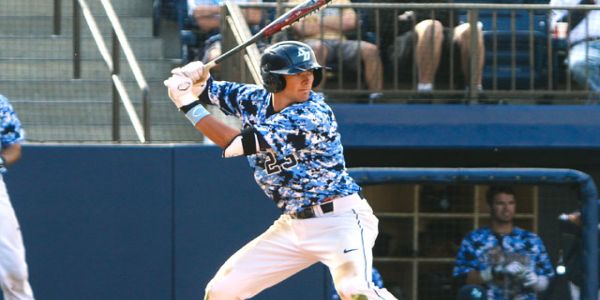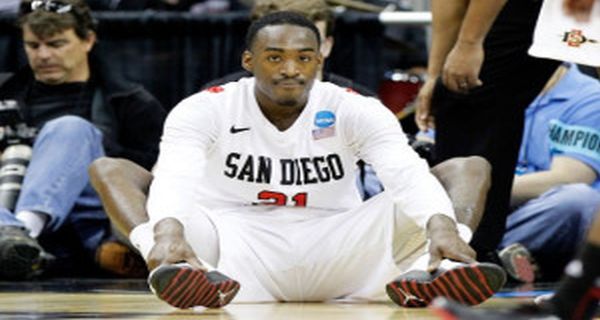
Profiling The 2013 MLB Draft: University of San Diego’s Kris Bryant

Prospect Profile:
Kris Bryant
Position:  3B/OF/1B
Height:  6-5
Weight:  215
Bats/Throws:  R-R
Birthdate:  Jan. 4, 1992
College:  San Diego
2013 Class: Junior
Hometown:  Las Vegas, Nev.
High School; Bonanza
Previously Drafted:  Blue Jays 2010, 18th round
Projected 2013 Draft Round: 1st
[Read more...]

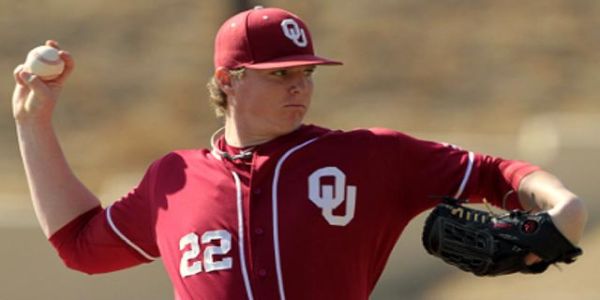
Scouting The 2013 MLB Draft: Oklahoma’s Jonathan Gray

Gray

Sometimes scouting is exceedingly difficult. The footwork necessary to successfully turn a double-play, a batter being able to cover the outside pitch without opening up a hole inside, the softness of a catcher’s hands aiding him in framing pitches; these skills can best be seen by experienced and dedicated scouts. Some players, however, don’t necessitate the kind of scout savvy that only exists in Clint Eastwood’s mind.

Oklahoma RHP Jonathan Gray is the second kind of player.

While a pitcher like Mark Appel may occasionally touch 97-98 MPH and that peak velocity will get reported as something sustainable, Jonathan Gray throws really hard all the time. His fastball sits 97-100 MPH. Sits! 97-100!! Exclamation points!!!

Gray’s arm strength is truly special. That strength adds RPMs to his breaking ball giving Gray a devastating slider/curve hybrid to compliment his elite fastball. A decent change-up occasionally works its way into Gray’s repertoire but the fastball/breaker has been enough to flummox collegiate hitters.

The only real knocks on Gray are that he hasn’t developed a third pitch all that well and scouts would like to see how he works out of the stretch and with men on-base a little more. The biggest knocks on Gray stem from the fact that he’s been too good. Gray has hardly been challenged at all this spring. That’s the bad.

Few things are as exciting as the visceral pleasure of someone throwing a baseball really, really hard. For the same reason the 100 meter finals draw much larger audiences than power walking, watching someone go all out in an athletic endeavor is innately appealing. Seeing anyone do something as well and fast and hard as humanly possible is impressive. In that sense Jonathan Gray is the most impressive pitcher in college baseball. His ability to generate force and apply it to a baseball is special and rare and very valuable.

Gray’s elite stuff has translated into amazing production. He has struck out 104 batters in just 89.2 innings this spring. Gray has walked a scant 16 hitters all season and only allowed 51 hits in his first 12 sterling Sooner starts.

He’s a big, strong young man from a small town in central Oklahoma. At 6-foot-4 and every bit of his listed 239 Gray is a burly, corn-fed, country kid straight out of central casting. A little better athlete than he’s sometimes given credit for, Gray has the physical build scouts refer to when they tag someone as a “potential workhorse”. While the actual likelihood of Gray suffering an arm injury is fairly high, that stems from the incredibly high baseline rate of injuries for pitchers of elite velocity. When generating that much force, there’s more energy around to potentially find its way into the arm. Nothing about Gray’s mechanics jump out as elevating his injury risk.

A bad run of luck with the magical arm injury fairy is about the only thing standing between Gray and MLB stardom. Players with his arm and production don’t fail very often. Command of a 100 mile per hour fastball tends to translate to success.

Gray’s game is all about power. Despite sneaking up draft boards this spring Gray’s rise to prospect prominence has actually been a steady one. Drafted twice before, Gray threw in the low-90s out of high school and worked his way up to the middle-90s after spending time at Eastern Oklahoma State Junior College. Jonathan Gray didn’t come out of nowhere; he just keeps working and keeps getting better.

I like Gray more than current Pittsburgh Pirate farmhand and number one overall pick in 2011 out of UCLA, Gerrit Cole. Mark Appel is a really good pitching prospect and will likely have a fine major league career, but Jonathan Gray has a chance to be a true, dominating ace. At this point Gray is one of the three to five best collegiate pitching prospects of the last decade, with only David Price and Stephen Strasburg firmly above him in my mind.

Gray has the potential to be a top five overall pitcher and league leader in strikeouts.

The future doesn’t always work out as it should or even how we think it ought to. Maybe Jonathan Gray never comes close to such lofty praise. All one can do is make the best decision based on the information available at the time. Given his stuff, production and history of improvement Gray is the kind of prospect you have to really question taking anyone else over.

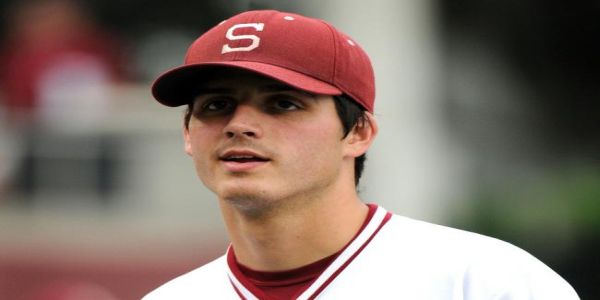
Scouting The 2013 MLB Draft: Stanford’s Mark Appel

Mark Appel is finally pitching like the star he’s been made out to be.

The Stanford right-hander entered the 2012 draft as the number one prospect on media draft boards and in his own mind or, at least, the mind of his agent, the Baseball Antichrist Scott Boras. Appel’s slide to the Pittsburgh Pirates and the eighth overall selection shocked many. Theories emerged as to why a prospect as elite as Appel could drop in the draft. Money was the general consensus yet the real reason was likely talent. In 2012 Mark Appel was a very good pitching prospect, but not the elite, top-of-the-draft, franchise type talent he was made out to be.

For all the guff Appel endured off the field last summer, this spring’s performance on the field has made up for it. After striking out 9.5 batters per nine innings as a junior, Appel has upped that number to 10.7.

Appel has gone from a solid swing-and-miss guy as a junior, for an elite draft prospect, to a terrific one. Gaining over a strikeout an inning isn’t a guarantee of MLB success, but the failure to do so is pretty much a death-nail in a player’s big league dreams. Daniel Moskos, Greg Reynolds and Jeremy Sowers were all taken in the top 10 as college pitchers who failed to strike out a batter an inning and all three were among the biggest busts in recent draft history. (Side note: there may be more guys who fit the bill drafted earlier but college stats are really hard to come by before 2001-ish.) In fact, only Paul Maholm has drafted in the top 10 overall as a college pitcher who struck out under a batter an inning in college and has gone onto any sort of quality big league career – Maholm struck out 101 opponents in 107.2 innings for Mississippi State his junior year before being taken eighth overall by the Pirates in 2003.

If Paul Maholm is your upside, Appel better be glad he’s gone from good to great production this spring, Maholm’s strong start to this season notwithstanding. The real question is: has Appel’s increased production been caused by an increase in core skill?

Appel’s stuff is sharp. His fastball sits 92-95 MPH and is thrown with a down-hill plane. Appel’s go-to secondary offering is a plus change-up and he mixes in an average slider as well. His breaking ball is currently his third best pitch, a low-80’s slider with late 1-7 break, but has the potential to be above-average. Appel’s control is strong (14 BBs in 78.2 IP). He’s a big, strapping, athletic guy who can throw three quality pitches for strikes and comes from a big-time program. There’s a lot to like about Appel’s future.

Although, everything in the previous paragraph could have pertained to Appel last season as well. The main difference in Appel’s production is his age. Simply put, Appel is a senior and seniors tend to be the best players. Appel (who turns 22 years-old in July) spends his days dominating 18, 19 and 20-year-olds. Those few years may not seem like a lot, and of course some of his opponents are Appel’s age or older, but the late-teens and early 20’s represent a steep ascent on the aging curve. Just because Appel is closer to his peak doesn’t make the peak itself any higher.

Mark Appel is in the mix for the Houston Astros, owners of the first selection in June’s draft. Drafting Appel would represent a major talent acquisition. The Cardinal righty would waltz into the Astros’ farm system and immediately be the best pitcher in the entire organization. He’s a relatively safe pick; almost no scenario exists where Appel stays healthy and does not turn into at least a quality major league starter in relatively short order.

However, Appel’s brilliant spring and the media hype around him should not obscure the fact that he’s basically the same exact pitcher who major league teams thought was only the eight best prospect in a mediocre draft last year. There’s a reasonable chance Appel turns into a quality number two starter, a staff ace in Houston by a country mile, but much above that seems unlikely.

Appel has two plus pitches, a quality third offering and above-average control. He lacks a dominating put-away pitch or the elite command of a true ace. While his stats have improved this spring the numbers have not correlated with a rise in overall stuff.

Appel may develop into a top 50 overall pitcher; a potential 200 inning guy with 175-ish strikeouts and an above-average ERA and WHIP at his peak. But anyone expecting Appel to be in the class of David Price or Stephen Strasburg, recent number one overall picks, may be left wanting.

Scouting the Final Four: Point Guard Lotto

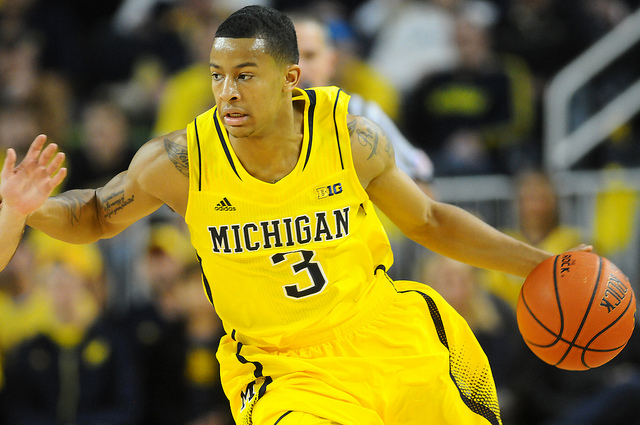
College Basketball Trey Burke

Photo Credit: Adam Glanzman

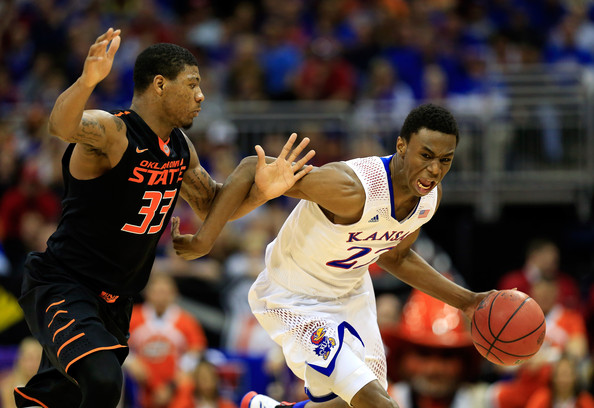
Trey Burke, PG Michigan- Burke has earned himself a healthy payday come June with his machinelike consistency (double figures scoring in all 37 games) and efficiency (46%/38%/80%) as a junior. Entering the NCAA Tournament, it was believed by most NBA decision makers that Burke had already shown his full repertoire, and that his draft stock was essentially set in stone. Frequent knocks on Burke surrounded his casual demeanor and somewhat emotionless on-court style – in other words, how much does he want it? The final 1:55 of regulation and proceeding overtime against Kansas on Friday the 29th put an end to those queries. 6:55 of innate fortitude and shot making, of carrying his teammates over the finish line, singlehandedly moved him up a handful of spots in the lottery. Burke is not the quickest point guard in America, but he’s mastered the “change of pace” and has the ball on a string. He does his best work shooting off the bounce, using his handle and/or compact frame to create space for his patented step back jumper.  As a result of his proficiency converting low percentage jump shots, he can create his own shot at will, which ironically has often resulted in critical evaluation of his team running skills. However, it’s difficult to argue with 6.8 assists and a 3.4 AST: TO ratio. Burke’s comfort level in the pick and roll will serve him well at the next level. Many of the current lottery teams already have lead guards in place, but Dallas would be an ideal landing spot.

Michael Carter-Williams, PG Syracuse- Carter-Williams is still very much a work in progress and will require heavy seasoning in the pros. He possesses intriguing size and court vision for the position, dishing out double-digit assists on 11 different occasions. Carter-Williams truly thrives is in transition, where he can gallop like a gazelle and survey the court free of distraction. It’s in the half-court where the clutter clouds his decision making process, and he’s a frequent candidate to force the action unnecessarily (3.4 TO). Length and quickness can get him to the rim, but his lack of strength often prevents the finish or makes him skittish to seek out contact. He must add muscle to his 185 pound frame. MCW took advantage of a favorable matchup versus Indiana, scoring both inside the lane and behind the three-point line en route to 24 points. He posted a typical 12 point/8 rebound/6 assist/5 steal line versus Marquette. If (and when) he finds his footing at the next level, the above triple slash is very much indicative of his all-court potential. It’s difficult to gauge one-on-one defensive skills in a zone structure, but he possesses the requisite length to disrupt a game, that much is for certain. He’s currently slotted in the back end of the lottery, but Boston could be an interesting destination if he slips. Akin to Rajon Rondo, Carter-Williams is a viewed as a confounding variable among scouts and presents an unorthodox package for teams to evaluate.

Freshman to Watch: Jerami Grant, F Syracuse- Blessed with all the athleticism in the world, Grant lost his way when James Southerland returned to the lineup, and has subsequently lost his spot in the rotation. Nevertheless, he could play a large role crashing the offensive backboard against a finesse Michigan team undersized at the 4-spot. He’ll need to step foot on the court for more than three minutes to leave an imprint. Either way, next year will be an explosive step forward for Grant, a conceivable 2014 lottery selection.

Follow on twitter @AdamGaneles

NCAA Tournament Preview: The Forgotten Four

Jamaal Franklin NCAA Tournament

Photo Credit: The Jordan List

Midwest: #6 Memphis

Critics of the Tigers have not hesitated to blast a less than stellar conference schedule at every opportunity. And while I don’t disagree with the poor product that the C-USA puts out, projecting NCAA Tournament performance based solely on affiliation and strength of schedule is unwise. Instead, I will choose to evaluate Memphis based on the talent they put forth on the court. After all, talent wins games in March. The Tigers boast depth, size, dynamite point guard play in Joe Jackson and a saturation of athletes. They rank 4th in the country in assists, 4th in blocks, 18th in steals and 38th in rebound margin. Head coach Josh Pastner and crew haven’t advanced a round in two years. It’s time to halt that streak. Neither Middle Tennessee State nor St. Mary’s CA scare me in the round of 64. Michigan State will be an obvious chore in the round of 32, but the Spartans have execution flaws. Ignore Memphis at your own risk, as they are highly capable of stringing together multiple wins. Player to watch: Adonis Thomas – Thomas was viewed as a potential lottery pick prior to ankle surgery last season. He’s a 6’7 240 wing with inside/outside versatility and tremendous athleticism. Mismatch nightmare.

[Read more...]

2012 NCAA Football: Notre Dame, Fact or Fiction?

Picture

Fiction #1 – Notre Dame’s defense is only about its front seven.

Fact – The defensive backfield has been surprisingly outstanding this year.

From the first game of the season many observers figured that Notre Dame would be strong up front but their Achilles heel would be their pass defense. As each week passed I kept waiting for the inevitable to happen and for Notre Dame’s backfield to be lit up, but guess what, it never happened. Never. Quarterbacks had some success here-and-there, but Notre Dame’s plan played out very well by keeping the play in front of them, even when cornerbacks where forced to play one-on-one. Notre Dame’s pass rush has been good but slow to start. The fact that the front line has dominated teams against the run has certainly helped the defensive backfield by allowing the linebackers to change up schemes and participate in pass defense. But don’t think for an instant that defensive backs throughout the year didn’t have to play strong one-on-one coverage. They did and they did.

Zeke Motta has led the crew and knows how to tackle. It’s between him and junior cornerback Bennett Jackson for the most outstanding DB this year. Jackson is the most underrated and least talked about player on Notre Dame’s defense. Try to find an article about him or positive comments from TV announcers. It’s like he doesn’t exist. I guess that’s a very good thing for a cornerback.

Fiction #2 – Notre Dame’s offense is a liability

Fact – Notre Dame’s offense has controlled the line of scrimmage.

Notre Dame has consistently driven the ball down the field and controlled the football. A big concern for Notre Dame starting the season was that even though they have a great defense they would tire since they would have to be on the field most of the game. It hasn’t happened. Thanks to a solid offensive line, multiple underrated skilled players and a quickly maturing, multi-dimensional quarterback the offense is good and better than most think. They have not been dominated this year and in fact they scored more points against Stanford than Oregon did. Yes, you read that right. Notre Dame’s offense has helped the defense more than people know. The real issue for the offense has been finishing the job. The red zone offensive production has been the only disappointment this year.

Fiction #3 – Notre Dame Can’t Beat an SEC team

Fact – They can and it’s a simple formula.

Continue what they have been doing on both offense and defense
Score TD’s in the red zone
Minimize turnovers

If I could give any advice to Coach Kelly it would be this:

Keep Theo Riddick and/or Cierra Wood in the backfield in the red zone. They play an integral part of a well balance offensive attack and you move the ball down the field on the ground and in the air. Don’t go empty backfield inside the 20 as you did against USC. You limit your options. Now get to work on you red zone offense. You are going to need to if you plan on raising the National Championship trophy.

Written by Steve Wright for TheFantasyFix.com.